Build a shipping policy that answers delivery-time, fee, tracking, address, and failed-delivery questions before customers need to contact support. This guide focuses on decisions a small or growing merchant can apply without adding unnecessary complexity. The goal is a store experience that is understandable to customers and workable for the people who process the order.
For app-specific context, you can also use the Instant COD App Guide and the installation guide alongside this article.
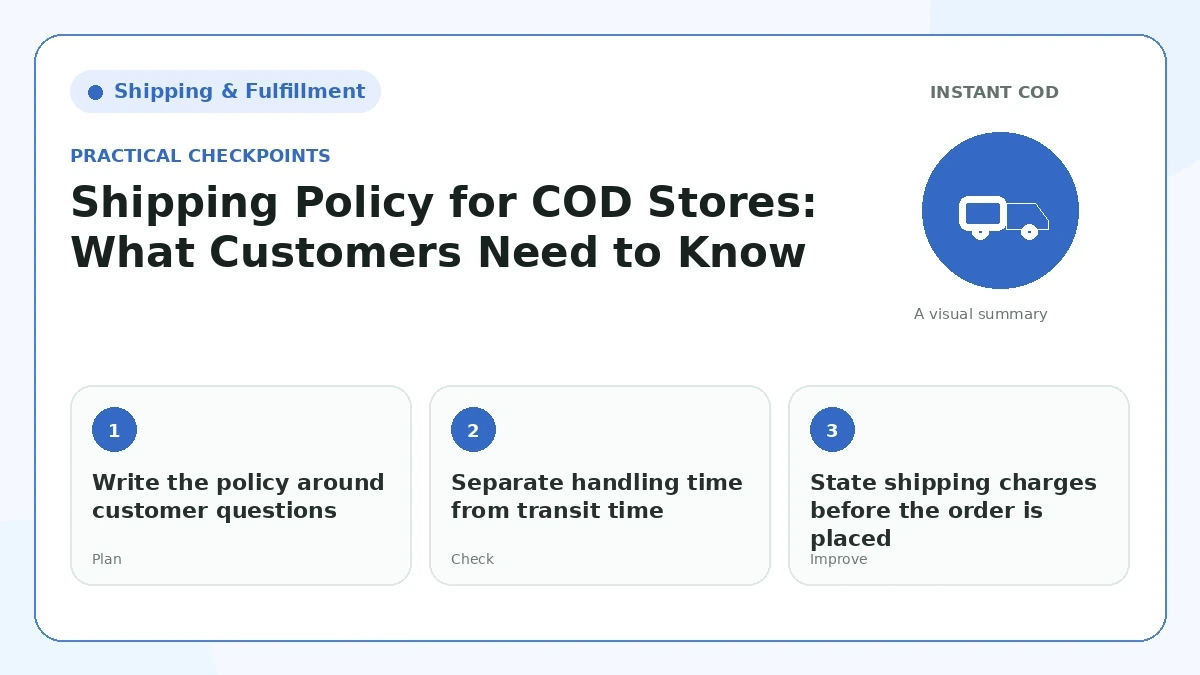
Write the policy around customer questions
A shipping policy is useful when it answers the questions a buyer naturally has before placing an order: where you deliver, what delivery costs, how long it usually takes, how tracking works, and what happens when a delivery attempt fails. Organize the page around those decisions instead of filling it with legal-sounding paragraphs.
For “Write the policy around customer questions,” make the change in a way your team can explain in one sentence. Then place a test order or open the public page as a customer would. If the result needs a long internal explanation, the customer-facing version is probably still too complicated.
Separate handling time from transit time
Customers often read a delivery estimate as a promise that the parcel will arrive within that exact window. Be clear about any order-processing period before the courier receives the package. If weekends, holidays, remote areas, or verification calls can change timing, explain that in plain language.
This part of the workflow should match the wording elsewhere on the site. Compare “Separate handling time from transit time” with the product page, policy pages, form labels, and confirmation message so a buyer does not receive two different versions of the same promise.
State shipping charges before the order is placed
If your store uses flat-rate, free-shipping thresholds, or city-based delivery charges, describe the rule consistently on the product page, COD form, and policy page. Conflicting information damages trust. Do not advertise free delivery in one place when the checkout later adds a fee.
A useful check for “State shipping charges before the order is placed” is to look at recent support questions and failed orders. Repeated confusion is evidence that the page or process needs clearer information, even when the design itself looks polished.
Explain address responsibility without blaming the customer
Ask buyers to provide a reachable phone number and complete address, but keep the tone helpful. Give examples of useful address details such as house number, street, area, landmark, city, and region. Explain how customers can request a correction if they notice a mistake before dispatch.
Keep “Explain address responsibility without blaming the customer” easy to maintain. Prefer a rule or piece of content that can be updated in one place, documented for staff, and tested after a theme, app, courier, or policy change.
Describe tracking and failed delivery
Tell customers when tracking becomes available and how they can get it. Also explain the process after a missed call or failed delivery attempt. This reduces confusion and can lower avoidable returns.
On mobile, review “Describe tracking and failed delivery” with limited screen space and a slower connection in mind. Important information should remain readable without relying on hover effects, tiny helper text, or a sequence of popups.
Keep policy details aligned with the courier process
Review the policy whenever courier partners, rates, delivery zones, or handling practices change. A short accurate policy is more valuable than a long page that describes an old process.
Finally, do not treat “Keep policy details aligned with the courier process” as permanent. Revisit it after enough real orders or search data has accumulated. Small stores improve faster when they compare outcomes before and after a change instead of following a fixed template forever.
Practical review checklist
- Test the experience on a real mobile device.
- Keep customer-facing wording consistent with the store’s actual process.
- Make important support and policy information easy to find.
- Review the resulting Shopify order or public page, not only the front-end design.
- Update the guide or workflow when the platform or business process changes.
What a good implementation looks like
A strong implementation of Shipping Policy for COD Stores: What Customers Need to Know feels ordinary to the customer in the best sense: the next action is obvious, the wording matches what actually happens, and important details are available without searching through several pages. For the merchant, the same setup should create information that is easy to find in Shopify or in the public site editor. If a process depends on one staff member remembering a workaround, it is not finished yet. Document the decision, test it after changes, and keep the public explanation aligned with the real operation.
Continue with related guides
For the next step, you can also read Cash on Delivery on Shopify: A Practical Merchant Guide How to Build a High-Converting COD Order Form. The resource library keeps related COD, store setup, shipping, trust, and SEO topics in five focused categories.
Official references
For platform-specific details, review Shopify shipping and delivery documentation and Shopify order fulfillment documentation. Platform behavior and policies can change, so primary documentation should be checked when a decision depends on a current rule.
Final takeaway
A professional ecommerce workflow is usually the result of many small decisions being consistent: clear wording, realistic expectations, useful customer details, accessible support, and a process the team can actually follow. Keep the implementation simple enough to maintain, then improve it using real order and support data.
Frequently Asked Questions
What is the main goal of Shipping Policy for COD Stores: What Customers Need to Know?
Build a shipping policy that answers delivery-time, fee, tracking, address, and failed-delivery questions before customers need to contact support.
What shipping details should customers see before ordering?
Show the delivery charge or rule, the service area, an honest delivery estimate, and any important COD conditions before the customer submits the order.
How should I test a shipping change?
Use representative cities, products, cart values, and free-shipping thresholds. Confirm the customer-facing amount and then verify that the same shipping information is saved on the Shopify order.
How often should fulfillment rules be reviewed?
Review them whenever courier coverage, rates, free-shipping thresholds, product handling, or delivery times change, and when support or return data shows a recurring problem.