Write a return and exchange policy that explains eligibility, time windows, product condition, shipping responsibility, and COD refund handling. This guide focuses on decisions a small or growing merchant can apply without adding unnecessary complexity. The goal is a store experience that is understandable to customers and workable for the people who process the order.
For app-specific context, you can also use the Instant COD App Guide and the installation guide alongside this article.
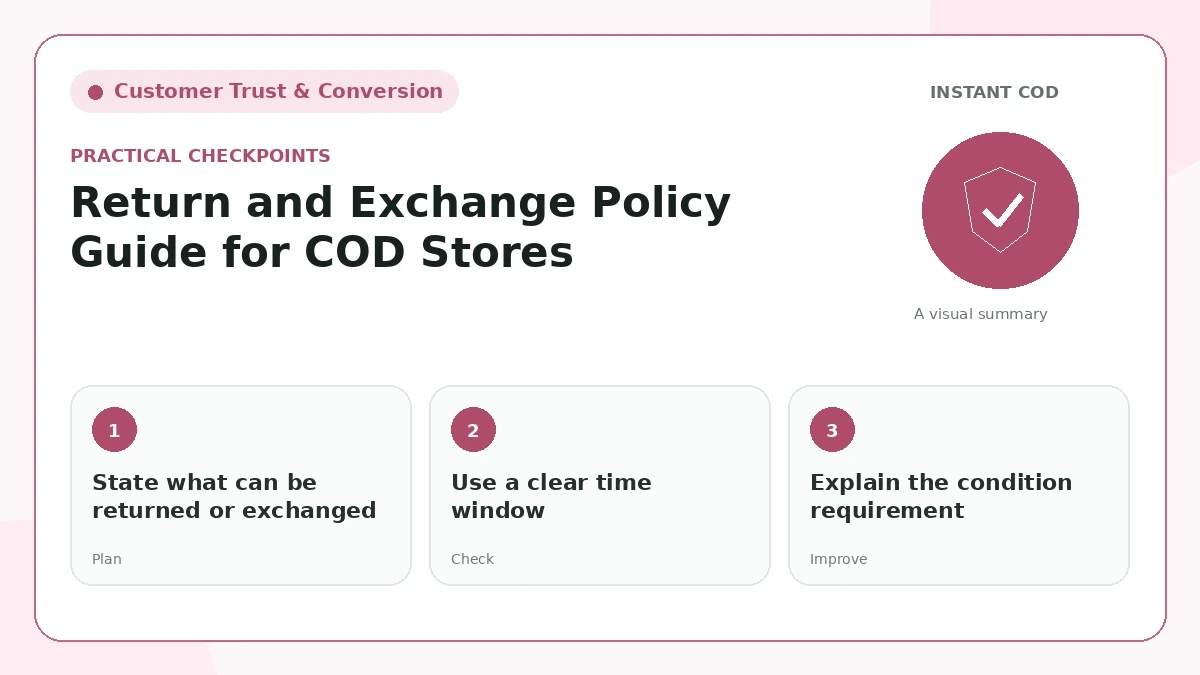
State what can be returned or exchanged
List product categories or conditions that are eligible and any reasonable exclusions. If hygiene, customized, clearance, or damaged-use conditions matter, explain them before purchase.
For “State what can be returned or exchanged,” make the change in a way your team can explain in one sentence. Then place a test order or open the public page as a customer would. If the result needs a long internal explanation, the customer-facing version is probably still too complicated.
Use a clear time window
Tell customers how long they have to report or send back an item and when the window begins. Avoid phrases such as “within a few days” that can be interpreted differently.
This part of the workflow should match the wording elsewhere on the site. Compare “Use a clear time window” with the product page, policy pages, form labels, and confirmation message so a buyer does not receive two different versions of the same promise.
Explain the condition requirement
Describe whether packaging, tags, accessories, or proof of purchase are needed. If the customer should record an unboxing video for damage claims, make sure that requirement is lawful, reasonable, and clearly communicated before the dispute.
A useful check for “Explain the condition requirement” is to look at recent support questions and failed orders. Repeated confusion is evidence that the page or process needs clearer information, even when the design itself looks polished.
Describe the COD refund method
COD orders cannot always be refunded in cash at the doorstep. Explain whether approved refunds are sent by bank transfer, mobile wallet, store credit, or another method, and what information is required.
Keep “Describe the COD refund method” easy to maintain. Prefer a rule or piece of content that can be updated in one place, documented for staff, and tested after a theme, app, courier, or policy change.
Separate change-of-mind returns from damaged-item problems
Customers should understand whether shipping costs or procedures differ when the product is defective, incorrect, or simply unwanted. This makes support conversations much easier.
On mobile, review “Separate change-of-mind returns from damaged-item problems” with limited screen space and a slower connection in mind. Important information should remain readable without relying on hover effects, tiny helper text, or a sequence of popups.
Keep the policy aligned with actual support practice
If staff regularly make exceptions, update the written policy or define who can approve them. A policy that support does not follow creates more conflict than having no policy at all.
Finally, do not treat “Keep the policy aligned with actual support practice” as permanent. Revisit it after enough real orders or search data has accumulated. Small stores improve faster when they compare outcomes before and after a change instead of following a fixed template forever.
Practical review checklist
- Test the experience on a real mobile device.
- Keep customer-facing wording consistent with the store’s actual process.
- Make important support and policy information easy to find.
- Review the resulting Shopify order or public page, not only the front-end design.
- Update the guide or workflow when the platform or business process changes.
What a good implementation looks like
A strong implementation of Return and Exchange Policy Guide for COD Stores feels ordinary to the customer in the best sense: the next action is obvious, the wording matches what actually happens, and important details are available without searching through several pages. For the merchant, the same setup should create information that is easy to find in Shopify or in the public site editor. If a process depends on one staff member remembering a workaround, it is not finished yet. Document the decision, test it after changes, and keep the public explanation aligned with the real operation.
Continue with related guides
For the next step, you can also read Mobile COD Checkout UX Checklist How to Build Trust on a New Shopify Store. The resource library keeps related COD, store setup, shipping, trust, and SEO topics in five focused categories.
Official references
For platform-specific details, review Shopify online store documentation and Shopify policies documentation. Platform behavior and policies can change, so primary documentation should be checked when a decision depends on a current rule.
Final takeaway
A professional ecommerce workflow is usually the result of many small decisions being consistent: clear wording, realistic expectations, useful customer details, accessible support, and a process the team can actually follow. Keep the implementation simple enough to maintain, then improve it using real order and support data.
Frequently Asked Questions
What is the main goal of Return and Exchange Policy Guide for COD Stores?
Write a return and exchange policy that explains eligibility, time windows, product condition, shipping responsibility, and COD refund handling.
What should I improve first if customers hesitate to order?
Start with the clearest source of uncertainty: product information, total price, delivery expectations, returns, contact details, or the checkout form. Make one meaningful improvement and measure the result.
How can I improve conversion without making the page feel pushy?
Use accurate product details, visible policies, clear calls to action, realistic delivery information, and concise reassurance. Avoid fake urgency, exaggerated claims, or distracting elements.
What should I measure after a trust or conversion change?
Compare relevant behavior such as product engagement, checkout starts, completed orders, support questions, cancellations, and returns rather than relying on a single metric.